
How to Mock an API Response for Testing: The Complete 2026 Guide
API mocking lets your team test confidently without touching a live backend. This guide covers every approach - in-code stubs, mock servers, browser interception, and shared scenario libraries - so you can ship faster with fewer surprises.

Every modern application calls dozens of APIs, and every one of those calls is a potential test failure waiting to happen. Network flakiness, rate limits, and backends that don't exist yet all conspire to slow teams down. API mocking solves this by returning controlled, predefined responses instead of hitting a real service - letting you test the logic that depends on the API, not the API itself [2].
In 2026, with the average enterprise integrating 50+ APIs and CI/CD pipelines running hundreds of test cycles daily, mocking is no longer optional. According to Postman's State of the API Report, 51% of developers spend more than 10 hours per week working with APIs [13], and API-related issues rank among the top causes of development delays. This guide walks through every practical approach to mocking an API response for testing - with concrete steps, tool recommendations, and team-workflow patterns that scale.
Mocks, Stubs, and Fakes: Get the Definitions Right First
Precision matters when discussing API test doubles. A mock replaces a real dependency and can verify interactions - was the endpoint called, with which parameters? A stub simply returns a hardcoded response without tracking how it was invoked. A fake is a lightweight working implementation, like an in-memory database [2].
A mock server is a standalone HTTP server listening on a real port, returning configured responses to any client that calls it - used for integration and end-to-end testing rather than unit tests [11]. Understanding which type you need prevents over-engineering: a unit test rarely needs a full mock server, and a full E2E test rarely survives on a simple stub.
Getting this taxonomy right shapes every tooling decision your team makes downstream.
5 Concrete Reasons Your Team Needs API Mocking in 2026
The case for mocking is stronger than ever. Here are the 5 problems it directly eliminates:

- Test flakiness: Network failures and third-party downtime cause failures unrelated to your code - mocking removes that variable entirely.
- API call costs: Running 10,000 test iterations against a paid payment API is expensive; mocked calls cost $0.
- Data pollution: Writing test records to production or staging databases creates compliance risk under HIPAA, PCI DSS, and CCPA.
- Parallelism bottlenecks: Frontend teams can't build against a backend that doesn't exist yet - mocking unblocks them immediately [14].
- Slow CI/CD pipelines: Real network calls add 200-2,000 ms per request; mocked responses return in under 5 ms, cutting suite runtime dramatically.
Over 40% of API developers cited lack of mocking capabilities as a significant workflow pain point in Postman's 2023 report [13] - a gap that compounds as microservice counts grow.
Each of these problems maps to a specific mocking approach, which the next section breaks down.
The 5 Core Approaches to Mocking an API Response
There is no single right way to mock an API response for testing - the best approach depends on the test level and team context. The 5 main approaches are:
- In-code mocking: Replace the HTTP client with a mock object inside a unit test. Zero network calls, millisecond execution.
- Local mock server: Run a real HTTP server (WireMock, Prism, json-server) on localhost; point your app at it for integration tests [11].
- Cloud mock server: Use a hosted service like Postman Mock Servers or Beeceptor to share a mock URL across the team [1][6].
- Browser/proxy interception: Intercept requests at the network layer using Playwright, Chrome DevTools Local Overrides, or a proxy tool like Charles Proxy [7][8].
- Shared team scenario library: Maintain a central library of reproducible app states - specific data combinations, error conditions, edge cases - activatable per isolated session without backend changes.
Approaches 1-2 suit individual developers; approaches 3-5 scale to cross-functional teams. The right stack often combines 2 or 3 of these layers simultaneously.
Step-by-Step: Mock an API Call in Jest in 3 Steps
For JavaScript unit tests, Jest's built-in mocking is the fastest path to a deterministic, network-free test. Here is the 3-step pattern [7]:
Step 1 - Import and mock the module: Call jest.mock('./apiClient') at the top of your test file. Jest replaces every export with an auto-mock.
Step 2 - Define the return value: Use mockResolvedValue({ status: 200, data: { id: 1, name: 'Alice' } }) on the specific function. This is the response your code will receive - no HTTP request is ever made.
Step 3 - Assert on behavior: Run the function under test and assert on what it does with the response - renders a component, updates state, calls a downstream function. The test validates your logic, not the API contract [2].
This pattern runs in under 10 ms per test and works identically in CI/CD pipelines with no environment configuration. For Python teams, the responses library applies the same principle by patching the requests library at the network layer.
Once unit-level mocking is solid, the next step is wiring up a mock server for integration coverage.
Set Up a Postman Mock Server in Under 10 Minutes
Postman Mock Servers turn a saved collection into a cloud-hosted mock endpoint accessible to every team member - no local server required [1]. The setup takes 4 steps:
- Open a Postman collection and add example responses to each request (status code, headers, JSON body).
- Click Mock Collection and give the server a name - Postman generates a unique URL like
https://abc123.mock.pstmn.io. - Point your application or test suite at that URL instead of the real API base URL.
- Add more examples to simulate different scenarios: a 200 success, a 404 not found, a 503 service unavailable.
Postman matches incoming requests to saved examples by URL path and method, returning the first matching example's response. For teams already using Postman for API documentation, this adds zero new tooling overhead.
Cloud mock servers work well for shared access, but teams needing stateful behavior or fault injection typically graduate to a local WireMock instance or a purpose-built scenario library.
Advanced Patterns: Stateful Mocking, Fault Injection, and Contract Alignment
Basic request-response mocking covers the happy path. Production-grade test coverage requires 3 advanced patterns:
Stateful mocking lets the mock server track state across calls - a POST to /orders creates a record, and a subsequent GET to /orders/42 returns it. WireMock's Scenarios feature implements this with named states and transition rules [11].
Fault injection is where most teams find the highest ROI. Configure your mock to return HTTP 429 (rate limit), 503 (service unavailable), malformed JSON, or a 30-second delayed response. Testing these failure modes before production is the difference between a resilient system and a 3 a.m. incident [10].
Fault injection scenarios to build into every test suite:
- HTTP 500 internal server error on the 3rd consecutive call
- Empty response body with a 200 status code
- Response delayed by 5,000 ms to trigger client-side timeout logic
- Malformed JSON to test error-handling branches
- HTTP 401 to verify token-refresh flows
Contract alignment prevents mocks from drifting away from the real API. Tools like Prism (Stoplight) auto-generate a mock server directly from an OpenAPI spec [5], so every mock response is guaranteed to match the schema the backend team is building against.
These patterns are the foundation of a mature mocking strategy - but they only deliver full value when the whole team can access and reuse them.
Avoid the 6 Most Expensive API Mocking Mistakes
Teams that adopt mocking without discipline create new problems. The 6 most common and costly mistakes are:
- Mock drift: The real API changes; mocks aren't updated; tests pass but production breaks. Fix: derive mocks from OpenAPI specs and run contract tests in CI [5].
- Over-mocking: Mocking so aggressively that tests never exercise real integration points. Keep at least 1 integration test layer that hits a real (or near-real) environment.
- Hardcoded test data: Static user IDs and amounts make tests brittle. Use response templating to generate dynamic values from request parameters.
- Shared mutable mock state: 2 developers sharing 1 mock server with mutable state cause intermittent failures. Use isolated sessions - 1 session per developer or test run.
- Happy-path-only mocking: Skipping 4xx/5xx scenarios leaves entire code branches untested [15]. Every endpoint mock should include at least 1 error scenario.
- No version control for mock definitions: Mock configs stored only in a GUI tool disappear when someone clicks delete. Store mock definitions in Git alongside application code.
Eliminating these 6 mistakes typically cuts flaky test rates by more than 60% within 1 sprint cycle.
Mocking as a Compliance and Risk Management Practice
API mocking is not just a developer convenience - it is a risk management practice for teams handling regulated data. Under HIPAA, testing against real patient data APIs risks PHI exposure; synthetic mocked responses eliminate that risk entirely. PCI DSS requires that cardholder data not appear in test environments, making mocked payment API responses the standard approach for any team processing card transactions.
GDPR and CCPA data minimization obligations mean that using real user records in test environments creates legal exposure. Mocked responses with synthetic data satisfy purpose-limitation requirements without any legal review overhead. SOC 2 audits are also simpler when test pipelines never touch production APIs - access controls and audit trails are easier to scope and demonstrate.
For enterprise teams, framing the mocking investment as compliance infrastructure - not just developer tooling - makes budget approval significantly faster.
With compliance covered, the final question is how to choose the right tool for your specific team context.
Choose the Right Mocking Tool for Your Team's Context
No single tool wins every scenario. Match the tool to the test level and team size:

- Jest / MSW: Best for JavaScript unit and component tests. Mock Service Worker intercepts at the network layer, so the same definitions work in browser and Node.js - 0 application code changes required.
- responses / pytest-httpserver: Best for Python unit tests. Patches the
requestslibrary with 3 lines of setup code. - WireMock / Prism: Best for local integration tests requiring stateful behavior, fault injection, or OpenAPI-driven contract alignment [5][11].
- Postman Mock Servers / Beeceptor: Best for quick team-shared cloud mocks with no infrastructure overhead [1][6].
- Playwright network interception: Best for E2E tests - intercepts real browser requests and returns controlled responses without a separate server process [7].
- Azure API Management / AWS API Gateway mocking: Best for enterprise teams exposing APIs to consumers before the backend is built [3][4].
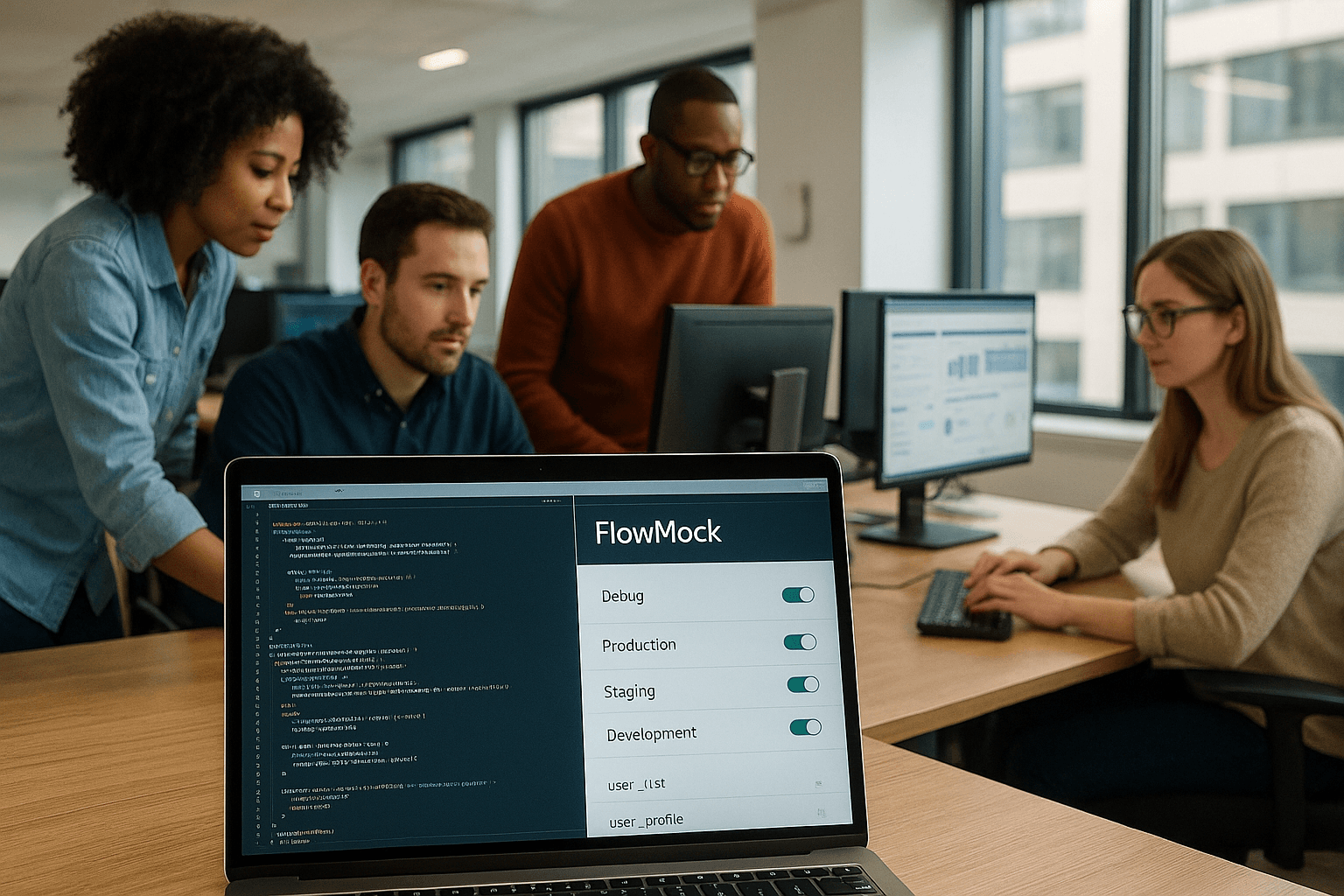
- FlowMock: Best for cross-functional teams (QA, dev, product) that need a shared library of reproducible app states - isolated sessions, scenario activation, and response transformation without any backend changes.
The most effective teams layer 2-3 of these tools: Jest for unit tests, WireMock or Prism for integration, and a shared scenario library like FlowMock for QA, product demos, and exploratory testing. Start with the layer closest to your current bottleneck and expand from there - most teams see measurable pipeline speed improvements within the first week of adoption.
FAQ
What is API mocking in software testing?
API mocking is the practice of simulating a real API by returning predefined, controlled responses - without calling the actual backend service. When a test or application makes an HTTP request to a mocked endpoint, an interceptor, stub, or mock server returns a crafted response (JSON body, status code, headers) that mimics what the real API would return under a specific condition. The purpose is to test the behavior of the code that depends on the API, not the API itself.
What tools are best for mocking API responses in 2026?
The best tool depends on your test level. For JavaScript unit tests, Jest's built-in mock functions or Mock Service Worker (MSW) are the standard choices. For Python unit tests, the 'responses' library or pytest-httpserver work well. For integration tests requiring stateful behavior or fault injection, WireMock or Prism are widely used. For quick team-shared cloud mocks, Postman Mock Servers or Beeceptor require no infrastructure. For E2E tests, Playwright's network interception is the leading option. For cross-functional teams needing shared reproducible app states, FlowMock provides isolated sessions and a centralized scenario library.
How do I mock a 500 error or timeout in an API test?
In Jest, call mockRejectedValue(new Error('Network Error')) or mockResolvedValue({ status: 500, data: {} }) on your mocked HTTP function. In WireMock, configure a stub with a response body of fault: CONNECTION_RESET_BY_PEER or add a fixedDelayMilliseconds value to simulate a timeout. In Playwright, use page.route() with route.fulfill({ status: 500 }) to return a server error for any matching request. Testing these failure modes is critical - they verify that your application handles degraded API conditions gracefully rather than crashing or hanging.
Is API mocking safe for compliance-regulated environments?
Yes - in fact, mocking is a compliance best practice for regulated environments. Under HIPAA, testing against real patient data APIs risks PHI exposure; mocked responses with synthetic data eliminate that risk. PCI DSS requires that cardholder data not appear in test environments, making mocked payment API responses the standard approach. GDPR and CCPA data minimization obligations are satisfied when test pipelines use synthetic mocked data instead of real user records. SOC 2 audits are also simpler when test environments never touch production APIs.
What is a shared mock scenario library and why does it matter?
A shared mock scenario library is a centralized, version-controlled collection of reproducible app states - specific data combinations, error conditions, and edge cases - that any team member can activate on demand without changing the backend. Instead of each developer maintaining their own local mocks, the whole team (QA, dev, product) works from the same library. Isolated sessions ensure that activating a scenario for one user doesn't affect others. This pattern eliminates mock drift, reduces setup time for exploratory testing, and makes it possible to reproduce any app state - including rare edge cases - in seconds.
How is mocking different from integration testing against a staging environment?
Staging environments run real (or near-real) backend services and are valuable for final pre-production validation. However, they are slow to provision, expensive to maintain, shared across teams (causing interference), and unable to reliably reproduce specific error states on demand. Mocking complements staging by handling the fast, isolated, deterministic layer of testing - unit tests, component tests, and scenario-specific integration tests - while staging handles final end-to-end validation. Most mature teams use both: mocking for 80-90% of test coverage and staging for the final integration gate before deployment.
Further reading
NIST provides authoritative guidance on security strategies for microservices, which is essential when implementing API mocking in complex architectures.
IEEE Computer Society offers peer-reviewed research on software engineering practices that help teams optimize their testing and development workflows.
Carnegie Mellon Software Engineering Institute hosts extensive resources on software architecture and quality assurance, providing a foundation for robust API testing strategies.
W3C defines the fundamental architectural principles for web services, ensuring that your mocking implementations remain compliant with standard web protocols.
GOV.UK publishes comprehensive technical standards for API development, offering best practices for maintaining consistent and reliable service interfaces.
Sources
[1]: Postman official docs: step-by-step tutorial for creating mock servers with response examples.
[2]: Stack Overflow: community-validated explanation of the purpose of mock testing.
[3]: Microsoft Learn: tutorial for enabling response mocking in Azure API Management.
[4]: Microsoft Learn: Azure API Management mock responses for enterprise gateway-level mocking.
[5]: Stoplight: comprehensive mock API guide covering OpenAPI-driven mocking and contract alignment.
[6]: Beeceptor: cloud-based mock server supporting REST, SOAP, GraphQL, gRPC.
[7]: Playwright official documentation: network interception for HTTP/HTTPS in E2E tests.
[8]: Medium/Adequatica: browser DevTools and proxy-based mocking.
[10]: Gravitee blog: mocking for wide scenario coverage including error conditions and edge cases.
[11]: API7.ai: comprehensive guide covering strategies, tools, and best practices.
[14]: Gravitee blog: mock API for parallel frontend/backend development.
[15]: Zuplo Learning Center: practical guide covering edge cases and error scenario implementation.
Related articles

How to Simulate API States QA Can't Reproduce on Staging (2026 Guide)
QA teams in 2026 still lose 30-40% of their sprint time fighting staging environments that can't produce the exact API states needed to validate error handling, rate limits, or third-party failures. This guide shows you exactly how to break that cycle.
How to Test Different Backend States Without a Backend Change in 2026
Testing edge cases, error states, and complex data scenarios shouldn't require a backend deployment. In 2026, the fastest QA and product teams intercept and transform API responses at the network layer - reproducing any backend state in seconds, without touching the server.

How to Reproduce a Bug That Only Happens Sometimes (2026 Guide)
Sporadic bugs cost U.S. teams tens of billions of dollars annually-yet most debugging workflows still rely on luck. This guide gives QA, dev, and product teams a repeatable, tool-backed system to capture and reproduce any intermittent bug, every time.