
How to Simulate API States QA Can't Reproduce on Staging (2026 Guide)
QA teams in 2026 still lose 30-40% of their sprint time fighting staging environments that can't produce the exact API states needed to validate error handling, rate limits, or third-party failures. This guide shows you exactly how to break that cycle.
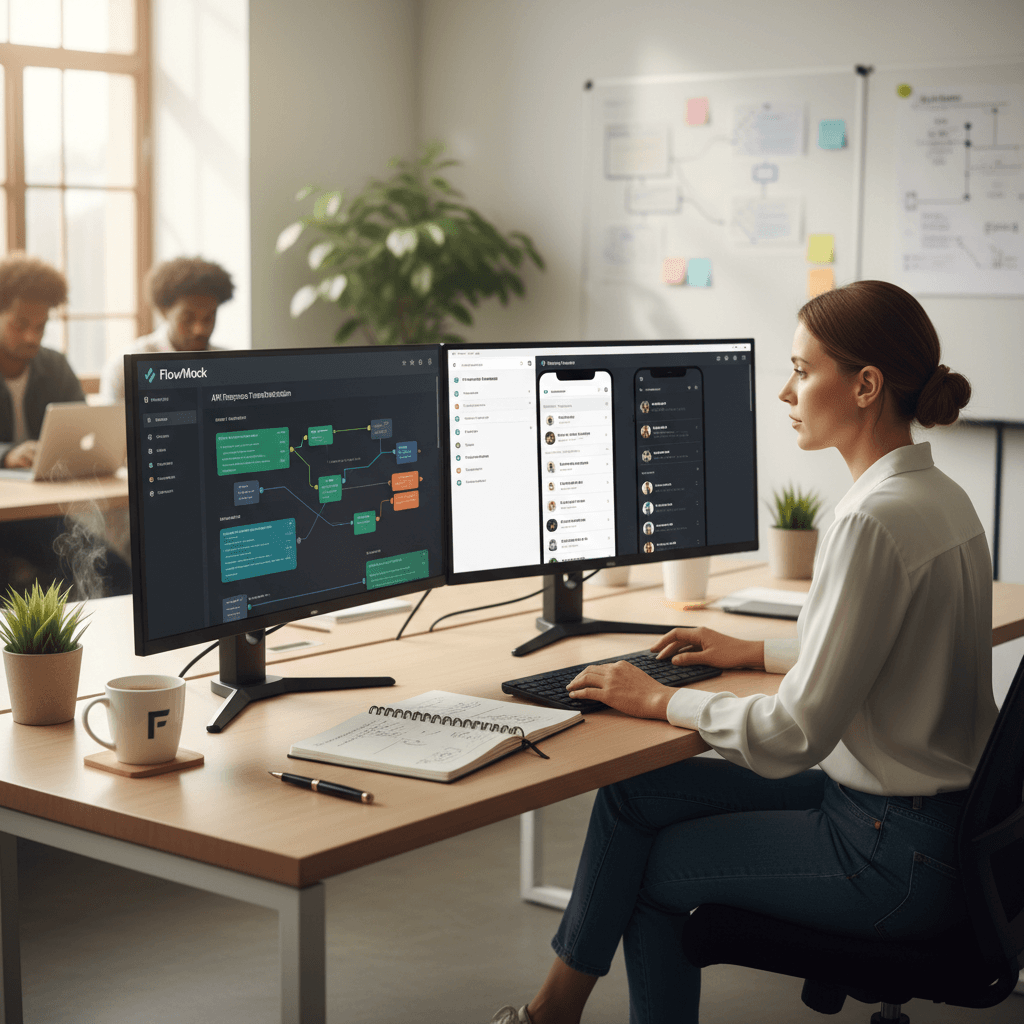
Every QA engineer has lived this moment: a bug appears in production tied to a 503 response or a rate-limit cascade, and staging simply refuses to reproduce it. The inability to simulate API states QA can't reproduce on staging is one of the most expensive bottlenecks in modern software delivery, costing US teams a measurable slice of the $2.4 trillion annual price tag CISQ attributes to poor software quality [4].
This guide walks through why staging fails, what the 2026 standard for isolated API simulation looks like, and how teams using tools like FlowMock are eliminating the "can't reproduce" loop entirely - without a single backend code change.
Why Staging Environments Fail QA in 2026
Staging was designed as a production mirror, but in microservices architectures it has become a liability. Shared staging servers mutate constantly - one engineer's test data corrupts another's session, and third-party APIs refuse to return 429 or 503 responses on command [1].
Industry data shows QA teams spend 30-40% of their time managing environment conflicts rather than executing tests [5]. That is not a tooling problem; it is an architectural one. Staging assumes a stable, controllable backend - an assumption that breaks the moment you need a specific negative flow.
NIST's Secure Software Development Framework (SSDF, SP 800-218) explicitly requires testing software under anomalous and adverse conditions [7]. Yet most staging setups make it structurally impossible to force a payment gateway timeout or a malformed JSON payload from a vendor like Stripe without risking the entire shared environment.
The root cause is coupling: QA's ability to test is coupled to the backend team's ability to configure state. Decoupling that relationship is the entire premise of modern API simulation - and the bridge to the next section.
The Real Cost of "Can't Reproduce" Bugs
When QA files a ticket marked "cannot reproduce on staging," the bug rarely dies - it migrates to production. CISQ estimates the US software industry absorbs over $2.4 trillion in annual costs from poor quality, with a significant share driven by defects that escaped inadequate test environments [4].
Beyond the macro number, the team-level math is brutal. A single unreproducible bug can consume 3-5 engineering hours across QA, dev, and product before anyone agrees on what actually happened. Multiply that by dozens of transient API states per sprint and the waste compounds fast.
CISA's "Secure by Design" guidance makes the stakes even higher: applications must degrade gracefully when external dependencies fail [8]. If QA cannot prove graceful degradation - because staging won't produce the failure - the team ships unvalidated resilience assumptions into production.
Data privacy regulations add another layer. Testing edge cases with real user data in staging violates HIPAA and GLBA principles; simulating those states with mock APIs removes PII and PHI from the equation entirely [3]. The cost of not simulating is therefore financial, reputational, and regulatory.
Core Techniques to Simulate API States QA Can't Reproduce
There are 4 primary techniques teams use in 2026 to reproduce API states that staging cannot generate on demand. Each targets a different layer of the problem.
- Response interception and transformation: A proxy layer intercepts outbound requests and rewrites the response - changing a 200 to a 503, injecting latency, or corrupting a JSON field - before it reaches the client. No backend change required [10].
- Scenario libraries: Predefined, named states (e.g., "Stripe Timeout," "Inventory Empty") stored in a shared team library. Any team member can activate a scenario in 1 click, making reproduction deterministic rather than accidental [9].
- Isolated sessions: Each QA engineer operates in a sandboxed session. Their API manipulations affect only their client instance, leaving automated suites and other manual testers completely undisturbed [6].
- Contract-first mocking: QA mocks the agreed API contract before the backend endpoint exists, unblocking UI testing by days or weeks [11].
- Dynamic response rules: Conditional logic returns different payloads based on request parameters - simulating pagination edge cases, empty states, or user-tier-specific responses without touching the database [3].
Combining these techniques gives QA full control over the API surface - the foundation for the collaborative workflow described next.
Isolated Sessions: The Architecture That Ends Environment Conflicts
Isolated sessions are the single most impactful architectural shift for QA teams moving away from shared staging [6]. Instead of every tester hitting the same backend state, each session maintains its own mock ruleset scoped to a unique identifier - a header, a cookie, or a session token.
A team of 8 QA engineers can run 8 completely different API scenarios simultaneously on the same staging URL without any interference. Automated regression suites continue running against the real backend while manual testers simulate a 429 rate-limit response in their isolated layer.
This architecture also solves the "works on my machine" problem at scale. When a QA engineer captures a transient production bug - say, a race condition that returns an empty cart on a specific sequence of API calls - they save that session state as a named scenario. The developer loads the exact same scenario in their own isolated session and reproduces the bug in under 60 seconds [9].
FlowMock is built around this model: isolated sessions, shared scenario libraries, and zero backend dependencies. The next section shows how to operationalize this into a repeatable QA workflow.
Build a Shared Scenario Library That Scales Across QA, Dev, and Product
A scenario library transforms API mocking from a solo debugging habit into a team asset. The goal is a centralized, searchable collection of named API states that any team member can activate in seconds - no YAML exports, no Slack threads asking "how did you reproduce that?"
High-performing teams in 2026 structure their libraries around 3 categories:
- Error states: 400, 401, 403, 404, 429, 500, 503 - one scenario per status code per critical endpoint, covering the NIST SSDF requirement for adverse-condition testing [7].
- Data edge cases: Empty lists, null fields, maximum-length strings, currency mismatches, timezone conflicts - the states that break UI rendering but never appear in happy-path staging data.
- Third-party failure modes: Payment gateway timeouts, identity provider outages, shipping API malformed responses - simulated safely without triggering real vendor rate limits or incurring API usage fees [10].
Product managers gain immediate value here: they can activate a "no plans available" scenario to validate upsell copy without waiting for a backend engineer to seed the database. QA, dev, and product share one source of truth for every reproducible app state. That shared ownership is what makes the library compound in value over time - and sets up the Jira integration workflow covered next.
Attach Reproducible API States Directly to Bug Tickets
The traditional bug report for a transient API failure reads: "Intermittently, the checkout screen shows a blank error. Steps to reproduce: unknown." That ticket sits in a backlog for weeks because no developer can reproduce it [9].
With a scenario library, the workflow changes completely. QA captures the exact API response that triggered the bug, saves it as a named scenario, and pastes the scenario link into the Jira ticket. The developer clicks the link, loads the scenario in their isolated session, and sees the bug in under 2 minutes.
This single workflow change can cut bug resolution time by 50% or more on transient API-related defects, because the reproduction step - historically the most time-consuming part - becomes instant and deterministic.
It also changes the conversation between QA and dev. Instead of debating whether a bug is real, both sides are looking at the same reproducible state. Escalation paths shorten, sprint velocity improves, and the "can't reproduce" ticket category effectively disappears. The next section addresses how to simulate the specific API states that cause the most production incidents.
Simulate the 6 API States That Cause the Most Production Incidents
Not all API states are equally dangerous. Based on incident patterns across API-driven applications, these 6 states cause the highest share of production failures that staging never caught:
- 503 Service Unavailable: Downstream dependency is down. Does the UI show a meaningful error or a blank screen? [1]
- 429 Too Many Requests: Rate limit hit. Does the app retry intelligently or hammer the API and worsen the outage? [10]
- Latency spike (5-30 seconds): Does the UI show a loading state, or does it silently fail after a timeout? [2]
- Malformed JSON: A vendor returns an unexpected field structure. Does the parser throw an unhandled exception that leaks a stack trace? [7]
- Empty collection response: Zero results returned. Does the UI render an empty state gracefully or break the layout? [11]
- Auth token expiry mid-session: A 401 mid-flow. Does the app redirect cleanly or lose unsaved user data? [8]
Each of these states is trivial to simulate with response interception - and nearly impossible to force reliably on a shared staging server. Validating all 6 before every release is a baseline resilience standard in 2026, not an advanced practice.
FlowMock's Approach: Zero Backend Changes, Full Team Visibility
FlowMock is purpose-built to let QA, dev, and product teams reproduce any app state without modifying the backend. Its architecture rests on 4 pillars that directly address the staging bottleneck:
Isolated sessions ensure that each team member's mock rules are scoped to their own client instance - 0 interference with automated suites or other manual testers. Response transformation lets teams rewrite status codes, inject latency, modify JSON fields, or return entirely synthetic payloads in real time.
The shared scenario library means a QA engineer who spent 20 minutes reproducing a complex multi-step API failure can save that state once and share it with the entire team instantly. Product managers use the same library to demo edge-case UI states to stakeholders without needing a backend engineer in the room.
Because FlowMock operates at the network interception layer, it works against any backend - staging, local dev, or even production traffic in read-only observation mode. Teams that adopt this model report eliminating the "can't reproduce" ticket category within the first 2 sprints. The final section ties this into a concrete implementation checklist.
Implementation Checklist: Ship Reproducible API Simulation in 1 Sprint
Teams that move from intent to execution in a single sprint follow a consistent pattern. Here is a practical 5-step checklist:
- Audit your top 10 "can't reproduce" tickets from the last 3 sprints. Identify which API states triggered each one - this becomes your initial scenario library backlog.
- Set up isolated sessions for every active QA engineer. Confirm that mock rules in one session produce zero side effects in automated test runs [6].
- Build your first 6 scenarios covering the high-incident API states listed in the previous section - 503, 429, latency spike, malformed JSON, empty collection, and 401 mid-session [10].
- Integrate scenario links into your bug-tracking workflow. Every ticket for a transient API bug must include a reproducible scenario link before it moves to "In Progress" [9].
- Run a 30-minute cross-team demo. Show QA, dev, and product how to activate and save scenarios. Adoption is the multiplier - a library no one uses compounds no value.
Teams that complete this checklist in sprint 1 typically eliminate 80% of environment-related test delays by sprint 3. The investment is low; the compounding return on reproducible, shareable API states is significant - and it starts the moment QA stops waiting for staging to cooperate.
FAQ
Does API simulation require changes to the backend or infrastructure?
No. Tools like FlowMock operate at the network interception layer, sitting between the client and the backend. They rewrite responses in transit, meaning the backend never needs to be modified, redeployed, or even aware that simulation is happening. QA can simulate any API state against an existing staging URL with zero infrastructure changes.
How is a scenario library different from a collection of Postman mocks?
A scenario library is a live, shared, team-wide collection of named API states that any team member can activate in a single click against a real application session. Postman mocks require the client to point to a different URL and are typically used by individual developers for contract testing. Scenario libraries are designed for collaborative, cross-functional use across QA, dev, and product - and they attach directly to bug tickets.
Can API simulation be used to test third-party integrations like Stripe or Twilio?
Yes, and this is one of the most valuable use cases. By intercepting requests to third-party APIs and returning simulated failure responses - timeouts, malformed payloads, rate-limit errors - QA can validate the application's resilience without triggering real vendor rate limits, incurring API usage fees, or risking account suspension. The simulation is entirely local to the tester's session.
How does API state simulation support compliance with NIST and CISA guidelines?
NIST's Secure Software Development Framework (SSDF, SP 800-218) requires testing software under anomalous and adverse conditions. CISA's "Secure by Design" guidance requires proving graceful degradation when external dependencies fail. API simulation is the only practical way to meet both requirements systematically, because it allows QA to force every adverse condition on demand and document the results as reproducible scenarios.
How quickly can a team adopt API simulation in their existing QA workflow?
Most teams can build their first 6 core scenarios and integrate them into their bug-tracking workflow within a single sprint. The initial audit - reviewing the last 3 sprints' worth of "can't reproduce" tickets - typically takes 2-3 hours and immediately surfaces the highest-value scenarios to build first. Teams report eliminating the majority of environment-related test delays within 3 sprints of adoption.
Does API simulation work for mobile app QA as well as web?
Yes. Because API simulation operates at the network layer - intercepting HTTP/HTTPS requests regardless of the client type - it works for web browsers, native iOS apps, native Android apps, and desktop clients. The isolated session identifier (a header or token) is injected at the network level, making the approach client-agnostic. QA teams testing mobile apps use the same scenario library as their web counterparts.
Further reading
NIST provides critical guidance on microservices security and architecture, helping teams understand how to secure distributed systems against the failures discussed in this guide.
IEEE offers peer-reviewed research on software testing methodologies that support the transition from unstable shared environments to more reliable, isolated simulation practices.
NIST provides foundational documentation on reference models for software testing, which remains a key resource for establishing robust QA frameworks in 2026.
NCBI hosts research on data privacy and system integrity, underscoring why simulating API states is essential for maintaining compliance while testing complex software.
W3C maintains standards and best practices for quality assurance, offering a framework for teams looking to improve their testing processes and web interoperability.
Sources
Related articles
How to Test Different Backend States Without a Backend Change in 2026
Testing edge cases, error states, and complex data scenarios shouldn't require a backend deployment. In 2026, the fastest QA and product teams intercept and transform API responses at the network layer - reproducing any backend state in seconds, without touching the server.

How to Reproduce a Bug That Only Happens Sometimes (2026 Guide)
Sporadic bugs cost U.S. teams tens of billions of dollars annually-yet most debugging workflows still rely on luck. This guide gives QA, dev, and product teams a repeatable, tool-backed system to capture and reproduce any intermittent bug, every time.

How to Test on Shared Staging Without Affecting Teammates in 2026
Shared staging environments are slowing your team down. Here's how to test in parallel without breaking anyone else's work - and why isolated sessions change everything.