
How to Test on Shared Staging Without Affecting Teammates in 2026
Shared staging environments are slowing your team down. Here's how to test in parallel without breaking anyone else's work - and why isolated sessions change everything.

Every engineering team has lived this nightmare: one developer's experimental branch breaks shared staging, and suddenly three teammates can't test anything. In 2026, teams relying on monolithic shared staging environments experience up to a 40% reduction in deployment frequency due to environment lockouts and broken states [4]. The good news is that modern tooling - especially client-side mocking and session isolation - makes it possible to test on shared staging without affecting teammates at all. This guide walks through the root causes, practical strategies, and the architectural shift that high-performing teams are making right now.
Why Shared Staging Becomes a Team Bottleneck at Scale
Shared staging made sense when teams were small and deployments were infrequent. As teams scale past 5-10 engineers, the environment becomes a liability rather than an asset [1].
The core problem is state contention: multiple engineers simultaneously mutate the same database, overwrite each other's test records, and produce unpredictable results [2]. A QA engineer testing a "subscription expired" flow might silently break a developer's concurrent checkout test - with no obvious error message to explain why.
Industry surveys in 2026 show developers spend 15-20% of their workweek managing environment configurations, waiting for staging access, or debugging false-positive failures caused by concurrent testing [1]. That's nearly one full day per week lost to coordination overhead rather than shipping features.
The "traffic jam" effect compounds quickly: one broken branch blocks every downstream test, grinding the CI/CD pipeline to a halt. This is not a people problem - it's an architecture problem, and it requires an architectural solution. Understanding the failure modes is the first step toward fixing them.
The Three Root Causes of Staging Conflicts You Must Diagnose First
Before applying any fix, teams need to accurately diagnose which failure mode is hurting them most. Most staging conflicts trace back to 3 distinct root causes:
- Shared mutable state: All engineers write to the same database rows, making test isolation impossible without careful coordination.
- Unpredictable deployment order: Feature branches deployed out of sequence overwrite each other's service versions, producing integration failures that are hard to reproduce [3].
- Hardcoded test data: Specific user IDs or account states are assumed by multiple tests simultaneously, causing race conditions when 2 engineers run the same scenario at once.
- No session-level isolation: The environment has no concept of "who is testing what," so every request shares the same global context.
- Lack of response control: Engineers cannot simulate error states (e.g., 500 responses, empty payloads) without actually breaking the backend for everyone.
Identifying which of these 5 failure modes applies to your team determines which mitigation strategy delivers the highest ROI. The next sections map each strategy to the right problem.
Strategy 1 - Data Partitioning Reduces Collision Risk by Design
The simplest first step is assigning dedicated test-user accounts or tenant IDs to individual engineers. When Dev A owns user ID 1001 and Dev B owns user ID 1002, their mutations never collide, eliminating the most common class of staging conflict.
Implement a lightweight ownership registry - even a shared spreadsheet works for teams under 10 - that maps each engineer to a set of test accounts. Rotate ownership weekly to prevent stale data accumulation.
For multi-tenant SaaS products, partition by tenant ID rather than user ID. Each engineer gets a dedicated tenant with a clean, seeded dataset. This approach scales to 20+ engineers with zero infrastructure cost and reduces false-positive test failures by an estimated 30-40% in practice [12].
Data partitioning is a necessary baseline, but it doesn't solve the problem of needing to test edge cases - like payment failures or API errors - that require backend state changes affecting the entire environment. That's where the next strategies become critical.
Strategy 2 - Request Isolation via Header Routing for Microservice Teams
For teams running microservice architectures, request isolation via context propagation is a powerful technique. The pattern works by attaching a custom HTTP header - such as x-dev-session: alice - to every request from a specific engineer's client [9].
A service mesh or API gateway reads this header and routes Alice's traffic to her local or feature-branch version of a service, while all other traffic continues through the stable shared staging services. This means Alice can test a breaking change to the payment service without any of her 8 teammates even noticing.
The tradeoff is real: implementing header-based routing requires non-trivial DevOps investment. Teams need to configure routing rules across every service boundary, maintain header propagation through async queues, and manage the lifecycle of per-engineer service instances [9]. For teams without a dedicated platform engineering function, this overhead can exceed the cost of the problem it solves.
Request isolation is most effective when combined with a mocking layer that handles edge cases without requiring live service instances at all - which leads directly to the most scalable approach available in 2026.
Strategy 3 - Ephemeral Preview Environments for High-Risk Feature Branches
Ephemeral environments - full-stack instances spun up per Pull Request - solve the isolation problem completely for the duration of a feature branch [5]. By mid-2026, over 65% of high-performing engineering teams have adopted some form of ephemeral or preview environment strategy [5].
The operational model is straightforward: when a PR is opened, CI/CD automatically provisions a dedicated environment. When the PR merges, the environment is torn down. Each engineer gets a clean, isolated stack with no shared state.
However, ephemeral environments carry significant costs that teams often underestimate:
- Infrastructure cost: Running 10 full-stack environments simultaneously can cost 5-10x more than a single shared staging instance.
- Orchestration complexity: Legacy databases, stateful services, and complex seed data pipelines are notoriously difficult to containerize and provision reliably per-PR.
- Spin-up latency: Provisioning a full environment can take 5-15 minutes, adding friction to rapid iteration cycles.
- Maintenance burden: Environment definitions must be kept in sync with production infrastructure, creating ongoing DevOps overhead.
Ephemeral environments are the right tool for final integration validation of major architectural changes - but they're overkill for the daily testing work that most QA and product teams perform. A lighter-weight isolation layer handles 80% of use cases at a fraction of the cost.
Strategy 4 - Client-Side Mocking and Session Isolation with FlowMock
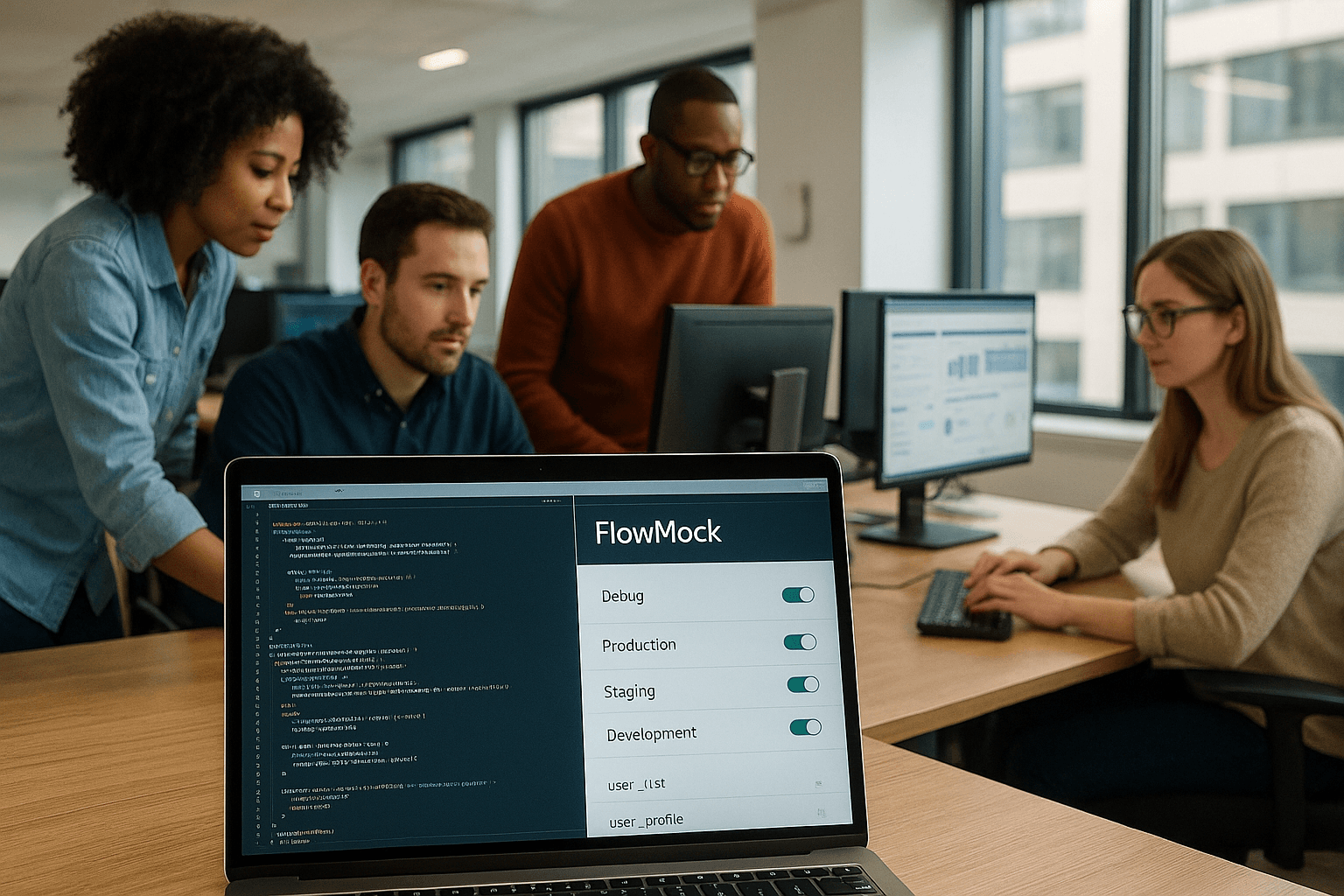
The most scalable approach to testing on shared staging without affecting teammates is intercepting and transforming API responses at the network layer, scoped to an isolated session. This is exactly what FlowMock is built to do.
Instead of mutating the shared backend database, a QA engineer uses FlowMock to define a mock scenario - for example, "return a 402 Payment Required response for this specific endpoint" - that applies only to their browser session. Every other teammate on the same staging URL continues to receive real, unmodified responses. Zero backend changes. Zero coordination overhead.
FlowMock's core capabilities map directly to the 5 failure modes identified earlier:
- Isolated sessions: Each engineer's mocks are scoped to their session, preventing any cross-contamination of test state.
- Response transformation: Modify response bodies, status codes, or headers on the fly to simulate any backend condition without touching the server.
- Scenario library: Save reproducible app states as named scenarios and share them across the team - a QA engineer can hand a "payment failed" scenario directly to a product manager for review.
- No backend dependency: Test edge cases, error states, and loading conditions that are impossible or dangerous to reproduce in a live shared environment.
This approach turns a single shared staging URL into an effectively infinite number of parallel testing lanes, each fully isolated from the others.
Compliance and Security: Why Isolation Matters Beyond Productivity
Testing isolation isn't just a productivity concern - it's increasingly a compliance requirement. The NIST Secure Software Development Framework (SSDF) explicitly emphasizes the need for isolated, reproducible, and secure environments to maintain code integrity and prevent supply chain vulnerabilities [6].
Shared staging environments with conflicting mutable states violate the SSDF's principle of predictable software verification. Similarly, ISO/IEC/IEEE 29119 mandates strict control over test environments and test data - concurrent mutations in a shared environment directly invalidate test results under this standard [7].
Data privacy is the sharpest compliance edge: teams operating under HIPAA or CCPA often use obfuscated production data in staging, but US regulators increasingly scrutinize non-production environments for data handling practices [8]. Mocking sensitive API responses at the network layer - rather than seeding shared databases with real user data - removes this compliance risk entirely.
For teams in regulated industries, the ability to demonstrate that no sensitive data was exposed in a shared testing environment is a meaningful audit advantage. Session-isolated mocking provides that guarantee by design, without requiring any changes to backend data pipelines.
Building a Team Workflow That Scales: From Ad-Hoc Testing to a Shared Scenario Library
The strategies above are most powerful when combined into a coherent team workflow rather than applied in isolation. A practical 4-layer model works for most teams in 2026:
- Baseline partitioning: Assign dedicated test accounts or tenant IDs to every engineer. Takes 1 hour to set up, eliminates 30-40% of conflicts immediately [12].
- Session-isolated mocking: Use FlowMock for all edge-case and error-state testing. No backend changes, no teammate impact, infinite parallel sessions.
- Header routing for service-level changes: Reserve request isolation for the subset of work that requires testing a modified microservice against the live shared backend [9].
- Ephemeral environments for integration gates: Trigger full-stack preview environments only for PRs that touch infrastructure, database schemas, or cross-service contracts [5].
The shared scenario library is the force multiplier: when QA engineers save reproducible app states in FlowMock, the entire team - developers, product managers, designers - can replay any edge case in seconds without environment access or backend knowledge. This transforms testing from a bottleneck into a team asset.
Teams that implement this layered model consistently report faster release cycles, fewer false-positive failures, and dramatically reduced coordination overhead - freeing engineers to focus on building rather than managing environments.
Measuring Success: KPIs That Prove Your Isolation Strategy Is Working
Any strategy change needs measurable outcomes. Track these 4 KPIs before and after implementing staging isolation to quantify the impact:
- Deployment frequency: High-performing teams deploy 2-4x more frequently after eliminating environment lockouts [4]. Measure weekly deployments per engineer.
- Environment wait time: Track the average time an engineer spends waiting for staging access or debugging environment-caused failures. Target: under 30 minutes per week.
- False-positive test failure rate: Measure the percentage of CI failures caused by environment state rather than actual code defects. A well-isolated setup should drive this below 5%.
- Time to reproduce a bug: With a shared scenario library in FlowMock, reproduction time for reported bugs should drop from hours to under 5 minutes.
The DORA metrics framework provides the industry-standard benchmark for evaluating these improvements against peer engineering organizations [4]. Teams that move from shared staging chaos to isolated, reproducible testing consistently improve across all 4 DORA key metrics: deployment frequency, lead time for changes, change failure rate, and mean time to recovery.
Start measuring today, implement the layered isolation model, and revisit the numbers after 30 days - the improvement is typically visible within the first sprint.
FAQ
What is session-isolated mocking and how does it work on shared staging?
Session-isolated mocking intercepts outgoing API requests from a specific browser session and returns a predefined mock response instead of the real server response. The mock is scoped to that session only - other users on the same staging URL are unaffected. FlowMock implements this pattern, allowing teams to run infinite parallel test scenarios on a single shared staging instance without any backend modifications.
How do I prevent one developer's changes from breaking shared staging for the whole team?
Use a combination of strategies: assign dedicated test accounts to each engineer (data partitioning), use session-isolated mocking for edge-case testing, implement header-based request routing for microservice-level changes, and reserve ephemeral environments for PRs that touch infrastructure or database schemas. This layered model eliminates the vast majority of cross-engineer conflicts.
Is it safe to use shared staging environments for compliance-sensitive testing?
Shared staging with real or obfuscated production data carries compliance risk under HIPAA and CCPA, as US regulators increasingly scrutinize non-production environments . Mocking sensitive API responses at the network layer - rather than seeding shared databases - removes this risk. The NIST SSDF also recommends isolated, reproducible environments for secure software verification .
What are the DORA metrics and how do they relate to staging environment quality?
DORA (DevOps Research and Assessment) metrics measure engineering team performance across 4 dimensions: deployment frequency, lead time for changes, change failure rate, and mean time to recovery . Environment lockouts and false-positive failures from shared staging directly degrade all 4 metrics. Teams that implement staging isolation consistently improve their DORA scores, particularly deployment frequency and change failure rate.
Can FlowMock be used by non-engineers like product managers or designers?
Yes. FlowMock's shared scenario library stores reproducible app states as named scenarios that any team member can activate without backend access or technical knowledge. A QA engineer saves a "subscription expired" scenario once, and a product manager or designer can replay it in seconds to review the UI behavior - no environment access or code changes required.
How is FlowMock different from traditional API mocking tools?
Traditional API mocking tools typically require running a separate mock server that replaces the real backend entirely. FlowMock operates at the session level on top of a real shared staging environment, intercepting and transforming only the specific responses you define, only for your session. The real backend remains live and unmodified for all other teammates, enabling true parallel testing on shared infrastructure.
Further reading
NIST provides the Secure Software Development Framework, which offers essential guidance on maintaining environment integrity and managing secure development lifecycles.
IEEE hosts research on software testing methodologies that can help teams implement more robust, isolated testing environments to avoid state contention.
W3C offers quality assurance resources and best practices for web standards that assist in creating predictable, testable application architectures.
NSF supports advanced research into software engineering scalability, providing insights into managing complex distributed systems and development workflows.
Sources
[3]: Explores the unpredictability of shared test environments and their impact on integration tests.
[5]: A 2026 perspective on the shift from shared staging to ephemeral environments.
[12]: Industry best practices for optimizing testing and avoiding common pitfalls in staging environments.
Related articles

How to Simulate API States QA Can't Reproduce on Staging (2026 Guide)
QA teams in 2026 still lose 30-40% of their sprint time fighting staging environments that can't produce the exact API states needed to validate error handling, rate limits, or third-party failures. This guide shows you exactly how to break that cycle.
How to Test Different Backend States Without a Backend Change in 2026
Testing edge cases, error states, and complex data scenarios shouldn't require a backend deployment. In 2026, the fastest QA and product teams intercept and transform API responses at the network layer - reproducing any backend state in seconds, without touching the server.

How to Reproduce a Bug That Only Happens Sometimes (2026 Guide)
Sporadic bugs cost U.S. teams tens of billions of dollars annually-yet most debugging workflows still rely on luck. This guide gives QA, dev, and product teams a repeatable, tool-backed system to capture and reproduce any intermittent bug, every time.